By Rachel Zabronsky and Charlotte Driscoll
The opinions expressed in this blog are solely the author’s and do not reflect the views of PayPal.
We believe that we are at the beginning of a wave of innovation aimed at better serving the financial and operational needs of small businesses[1] (SBs) around the world. Historically, these businesses have juggled numerous spreadsheets and clunky, disconnected systems, but that is rapidly changing thanks to new applications of the latest AI models. Financial tasks, particularly those directly connected to a business' core financial data and workflows, can now be accomplished more efficiently and accurately using artificial intelligence. The small business sector, which has historically been geographically and vertically fragmented, and slow to adopt new technology, is buzzing with startup innovation.
At PayPal Ventures, we think a lot about small businesses and what kinds of tools can make their lives easier. We believe that the platforms best positioned to win in the small business financial operations segment are AI‑native vertical solutions, powered by horizontal infrastructure players. These vertical startups often focus on solving problems at the root of a business’ complexity (e.g., accounting, AP/AR, reconciliation) before expanding into other parts of their financial operations. Within this value chain, we see horizontal players selling their point solutions into the vertical platforms that own the relationship with the small business. Meanwhile, standalone horizontal solutions become relevant as we move up to “medium‑sized” businesses with dedicated finance staffs and mature existing tech stacks.
Small businesses represent a massive and underserved portion of the global economy
SBs account for the majority of businesses worldwide and drive a disproportionate share of employment and innovation:
- In the United States, SBs employ nearly half of the private workforce and contribute approximately 44% of U.S. GDP (SBA, 2024).
- Worldwide, small businesses account for 90% of businesses and 50% of formal employment (World Bank).
Despite the size of the opportunity, we believe the segment is currently underserved with regards to technology tools, specifically software, that can improve productivity and operational efficiency. As of today, small businesses are only about half as productive per employee as larger businesses, and even less so in emerging economies (McKinsey). An actionable part of this gap can be attributed to slow tech adoption: a recent Federal Reserve survey showed that only 34% of US‑based small businesses currently accept digital or mobile payments (CB Insights).
A survey of the landscape highlights a white space to cater specifically to small businesses’ financial needs:
- Incumbent small business tech providers, such as Intuit QuickBooks and Xero, offer widely adopted freemium horizontal accounting solutions. However, many users cite challenges with categorization, error‑prone reconciliations, lack of automation, and clunky interfaces. Despite significant adoption, these players are not adapted to specific vertical workflows and offer limited AI‑driven functionality to save their customers from repetitive manual work.
- Enterprise‑grade solutions such as SAP Concur, Coupa, and Oracle NetSuite are designed for businesses that have dedicated finance and IT teams. They require lengthy implementations and training, offering more features than a small business needs, with pricing that doesn’t scale down.
- Solutions aimed at venture‑backed startups assume a higher level of expertise, customization, and spending appetite than what is suitable for an owner / operator‑led small business. For example, Brex focuses explicitly on “startups, mid‑sized companies, and enterprise,” and does not serve unincorporated businesses or those needing cash deposit or ATM withdrawals—making them a suboptimal fit for many small businesses.
Small businesses can be tough customers. The operating environment, and therefore software needs, of SBs is highly heterogeneous by both vertical and geography. They need tools that are easy to adopt, require minimal configuration, integrate seamlessly with existing workflows, and solve for vertical‑specific nuances. They demand a user experience that is as intuitive and enjoyable to use as leading consumer software, paired with the richness of enterprise solutions that handle the full complexity of their end‑to‑end operations.
AI can make manual financial workflows obsolete by unifying and analyzing disparate data sources
Zooming out, AI startups have attracted a wave of venture capital funding. Tens of billions of dollars have flowed into AI deals quarterly for the last several years, and investment has been increasing in the last six months (EY).
These investments are beginning to drive results. Where older AI models were best suited to language‑based tasks, newer models and applications can now reliably and accurately automate data‑oriented tasks, unlocking opportunities to streamline quantitative processes as well as qualitative ones.
Managing financial information is an incredibly resource‑intensive process in general. This burden is especially acute for small businesses whose budgets and time are highly constrained. But with AI, companies can unify disparate data sources into a single view. Instead of manually importing data from each provider every month, these tools can pull data across invoices, card transactions, bank statements, payroll, external vendors, and more into a single ledger with real-time reconciliation and expense categorization, automated reporting, and query‑able financial records.
We’ve already seen a substantial amount of capital flow into the space. Investors have concentrated small and medium business fintech funding on core infrastructure solutions: embedded payments, spend management, and cross border payments have raised 77% of funding across the sector since 2020 (CB Insights). We believe the startups that successfully solve the accounting and AP/AR needs of small businesses will be able to expand the products they offer across the rest of SBs’ financial workflows.
Longer term, these agentic AI tools could empower a solo CFO to spend their time on turning insights into actions, while the AI‑enabled software handles what was previously hours of recurring reporting, modeling, and budgeting work. For example, Cashboard aspires to automate away all manual execution jobs within small businesses’ finance functions, empowering employees to focus solely on higher‑value decision making.
Emerging themes in AI‑powered financial tooling for small business
1. Vertical platforms are leading the way by embedding financial tooling within industry‑specific workflows, often using spend management as the first step.
This functionality provides an entry point for platforms to become the default system of record over time. For example, in the construction industry, transactions require proactive review and coding before they can appear in a bank statement; invoices to subcontractors need to be validated before payments are disbursed based on the percentage of work completed. In healthcare, companies must reconcile complex patient billing and insurance reimbursement data (a16z). In brick‑and‑mortar operations, such as restaurants, small businesses need the capabilities to account for the small yet meaningful share of cash transactions alongside their card payments.
Vertical solutions have thrived in the small business sector, building trust with customers by solving the financial complexity at the root of sellers’ operations. Some exciting companies in the space include Housecall Pro (home services), Vergo (construction), Heard (therapy practices), and Pideaky (corner stores, Mexico‑based), just to name a few.
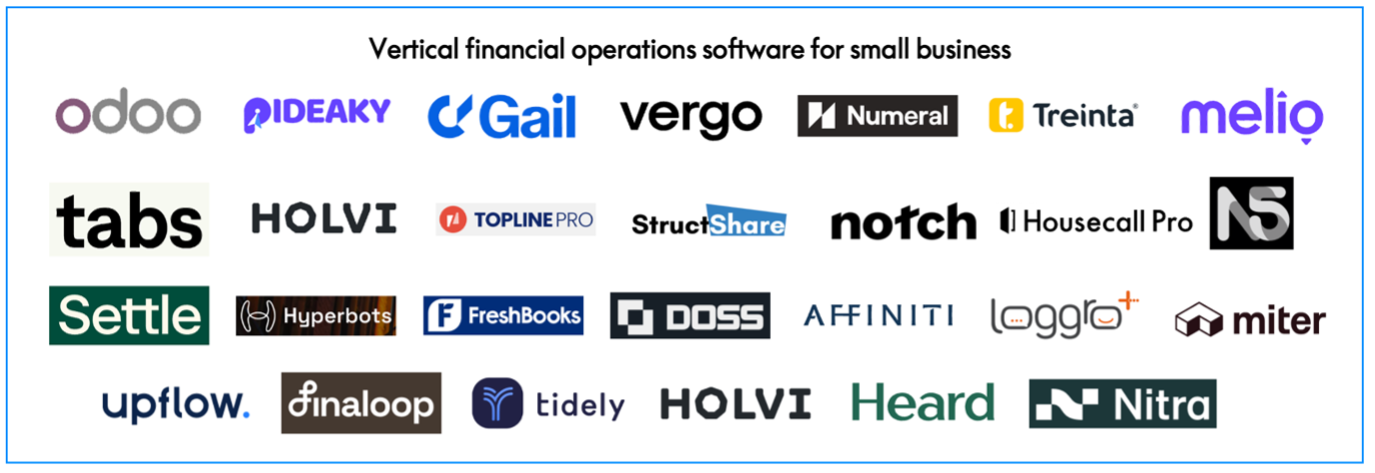
2. Horizontal solutions are increasingly acting as infrastructure providers that sell their toolkit into verticalized platforms that own the relationship with the small businesses.
We see this trend toward embedded payments and financial services across the broader startup ecosystem. For example, we invested in Gynger, which provides an AR/AP platform with embedded financing. We expect a similar market structure to evolve for small business financial operations, where horizontal providers sell through vertical platforms. For example, Tight has powered accounting solutions for 1.2M small businesses to date, selling through platforms such as Housecall Pro; and Layer provides vertical SaaS platforms with embedded bookkeeping and AI‑enabled customer support.
3. While the broad trend favors vertical platforms and embedded horizontal infrastructure, there are horizontal players with impressive traction building directly for more complex and well‑resourced “medium‑sized” businesses.
These players often succeed by offering a simple, consolidated product that appeals to businesses with dedicated finance teams and a more mature existing suite of software tools. For example, Found is an all‑in‑one banking and accounting solution targeted at small business. Their vision is to build AI‑powered “self‑driving books” to help businesses maintain their records without hiring accountants.
Concluding thoughts
Small businesses are long overdue for intelligent, industry‑aware financial software. For too long, they’ve had to choose between overbuilt enterprise tools versus underpowered generalist solutions. Now, that tradeoff is finally disappearing. At PayPal Ventures we believe that verticalized financial solutions and the horizontal infrastructure providers that sell into them ultimately will prevail in the small business sector. We expect the long‑term winners in the space to be those that deeply understand a small business’ operating environment and provide a one‑stop‑shop solution (either directly or via white‑labeled horizontals) that intelligently automate the entire financial workflow. In line with this vision, PayPal is committed to making it easier for small businesses to operate and scale by providing integrated, intuitive solutions that meet them where they are.
We’re actively looking to back founders building in this space. If any of this resonates with you, please reach out!
[1] In this context, we define “small businesses” as non‑venture‑backed companies where the owner/operator is responsible for financial operations. Relative to solopreneurs and micro‑business, the needs of small businesses are complex enough to require proper tooling (e.g., AP/AR, accounting, spend management, payroll). However, these companies lack the resources of a full CFO office (including accountants and controllers) that their medium‑sized competitors often enjoy.